
We find the risks that actually matter to your business, prioritize them honestly, and hand your team something they can budget, own, and act on. Every reporting box gets ticked along the way.
Companies starting out with climate risk usually treat it as an exercise in prediction, focused on a standard menu of physical and legal risks. But experienced climate modellers and risk analysts know that very little about climate outcomes can be reliably predicted. Climate models were never built to be prediction machines. The real value of the exercise is learning to relate climate risk to your business strategy in a simple, clear way that improves your ability to make good decisions.
Three rules shape every engagement we run:
Stop trying to predict everything that could happen and how likely each thing is.
Start focusing on the most important things that may or may not happen, and on improving your odds and your resilience either way.
The goal is equipping your team to make sound decisions about your business priorities, even in the face of deep uncertainty. A number that doesn't change a decision is decoration.
If a workshop, model, or report doesn't advance your understanding of climate risk and simplify the next decision, it doesn't belong in the project. We use powerful tools and participatory activities like En-ROADS and Climate Fresk to build your team's skill, not to decorate a deliverable.
Most assessments treat every risk the same way. In reality, each category calls for a different response. Drag each example into its category, then match the right response approach.
Drag and drop, or tap an item and then tap its slot.
You just did more honest risk categorization than most published climate reports. Imagine what we can do with your actual business.
Name removed. Numbers real.
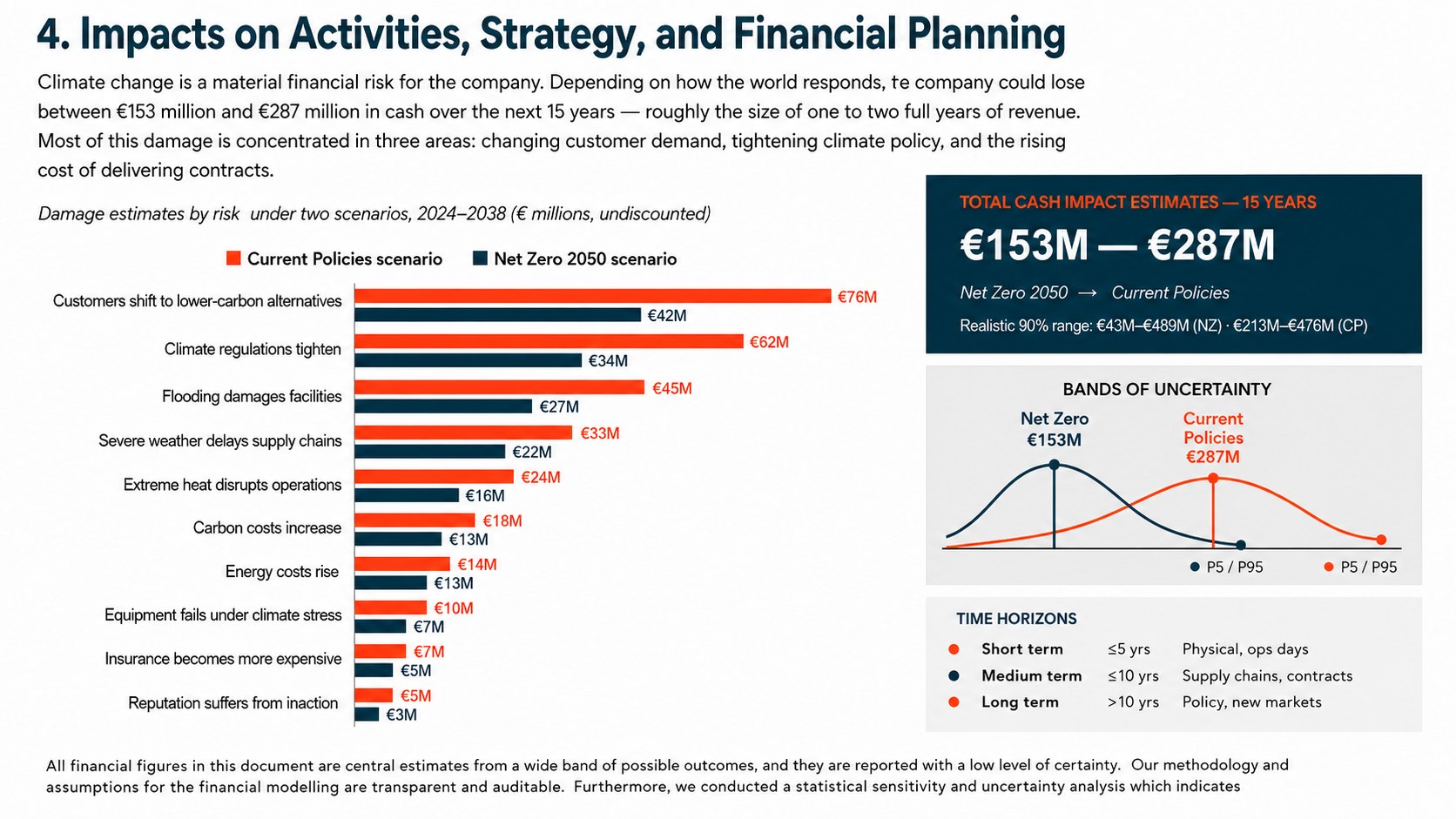
A page from the real analysis, name removed. Every figure carries its uncertainty band, and the methodology is transparent and auditable. Click to view full size.
Routine 45°C-plus summers, cooling-dependent operations, and acute water stress in a hyper-arid region.
Heatwaves intensifying across the region, drought stressing the water supply, and a glazed building that depends on the grid to stay workable.
Urban flooding that blocks access and power, chronic stress on the metro water supply, and air-quality episodes from regional fires.
Site-by-site physical risk is one input among many, because the most salient risk is rarely the most important one. And every priority risk maps to an owner, a working group, a budget, and indicators to watch. That's the governance layer most assessments skip.
Move the risk sliders to test each factor and watch the impact on the financials.
Missing the opportunity to demonstrate leadership
You provide clear leadership your colleagues recognize and appreciate
Slipping into check-the-box mode on an issue you personally care about
You make your strongest effort on the issues that matter to you
Failing to deliver the fundamental protective service your company expects
Your work meaningfully supports the broader business strategy
Failing to motivate action
The organization realizes it wants to act, and that it's already acting
Trying to predict the future
You get better at making good decisions in the face of uncertainty
Believing you can prioritize risks without a real transition strategy and risk-thinking skills
You understand your organization's role in a world affected by climate change
100% senior staff. No juniors learning on your budget.
Intergovernmental Panel on Climate Change lead author with 35 years advising 150+ international clients on climate risk. Mark founded the first corporate climate-risk consulting firm in the U.S. and co-authored the first textbook on climate risk for the London School of Economics.
He implemented the first-ever carbon offsetting projects and pioneered the concept of climate neutrality, helping the first companies go net zero in 1996. Clients have included HP, Nike, Suncor, the EPA, and Stonyfield Farm.
As Owner and Director of New Day, Keith assembles subcontracted teams of senior experts to deliver a level of value and expertise traditional consulting firms can't match at anywhere near the price.
15 years managing large teams in complex international environments, on five continents. Executive MBA from ESADE, MA in International Politics from IBEI. Clients have included USAID, Coca-Cola, Merck, Cigna, Siemens Gamesa, and Allianz.
Spain's Ley 7/2021 and its draft Royal Decree, CSRD and TCFD-aligned reporting in the EU, California SB 261. If you're required to show your work, it needs to hold up.
If you can't answer all six, that's the gap we fill.
Diligence teams and investors increasingly require credible evidence that climate risk is understood and managed before they commit. A weak assessment surfaces at exactly the wrong moment.
Operations, supply, or markets sitting in the path of physical or transition change, and you'd rather see it coming. Rarer than it should be, but it's the best reason on this list.
That's a good first conversation. A short, no-pressure call. We'll tell you honestly whether this is worth doing, and where to start.
Book an intro call →